
THE ESSENTIALS · 30-SECOND OVERVIEW
Suitability depends on the teeth, bite and intended change.
Discuss the difference between no-prep and minimal-prep veneers.
Consider alternatives, limitations and ongoing maintenance.
Explore suitability, limitations and alternatives before deciding how to change your smile.
For patients considering veneers in Turkey, the useful question is not simply whether a clinic offers a “no-shaving” option. It is whether that approach suits your teeth, bite and gum health. A conservative plan aims to preserve tooth tissue while also allowing a restoration that looks balanced, functions properly and can be cleaned.
What are no-prep veneers?
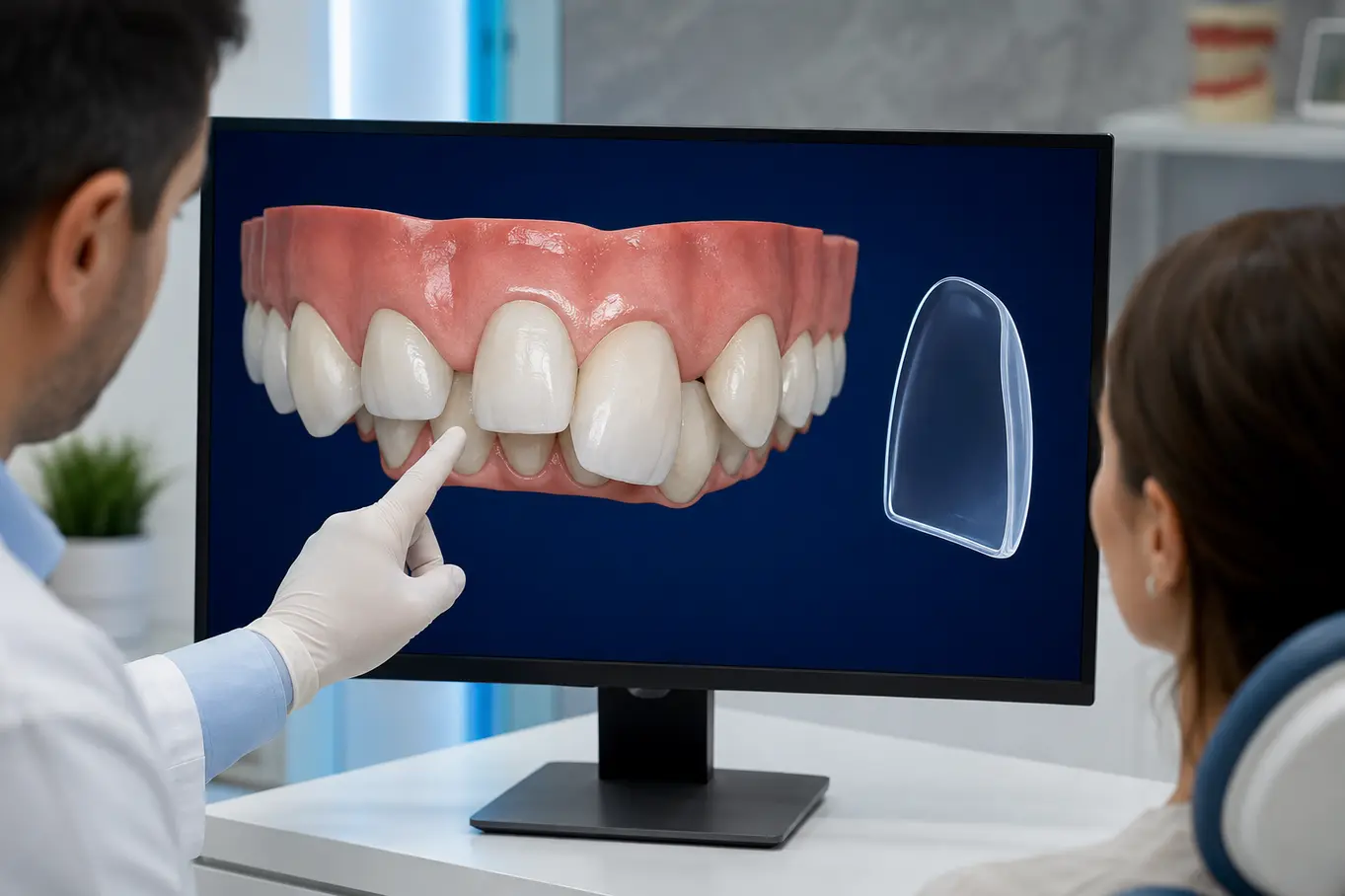
A veneer is a thin restoration bonded mainly to the front surface of a tooth. With conventional ceramic veneers, carefully controlled preparation may create space for the ceramic. A no-prep approach adds ceramic where the existing tooth shape can accommodate it without becoming excessively bulky.
Not all veneers are crowns. A crown covers more of the tooth and generally involves a different amount of preparation. Ask your dentist to explain the proposed restoration for each tooth, including whether any enamel will be removed.
Who may be suitable?
- People with naturally small or short teeth that would benefit from a modest increase in size.
- Selected small gaps between front teeth.
- Teeth positioned slightly inward, where adding controlled volume may be appropriate.
- Minor shape irregularities and limited colour changes that a thin ceramic layer can address.
- Healthy gums, sufficient enamel for bonding and an appropriate bite.
Photographs alone cannot establish suitability. Examination, photographs, a digital scan and sometimes a temporary mock-up help assess how additional thickness will affect the smile, lips and bite.

Plan your next step.
Discuss your questions
Agree an individual plan
Arrange follow-up
When might no-prep veneers be unsuitable?
Limitations include pronounced crowding or rotated teeth, teeth already positioned forward, very dark discolouration, large existing fillings, structural cracks, active gum disease and uncontrolled tooth grinding. These do not all require the same alternative; they require individual assessment.
Adding ceramic to a prominent tooth can make it look larger or push its contour farther forward. An overcontoured margin can also be harder to keep clean. Minimal preparation or orthodontic alignment before restorative treatment may offer a more conservative overall plan in these circumstances.
No-prep versus minimal-prep veneers
↔ Scroll sideways to compare
| Consideration | No-prep | Minimal-prep |
|---|---|---|
| Tooth preparation | No deliberate reduction in suitable areas | Limited, planned adjustment where needed |
| Space for ceramic | Depends on the existing tooth position and size | Preparation creates selected space |
| Colour masking | May be limited by a very thin layer | More space may allow different ceramic thickness |
| Shape control | Limited by the volume that can safely be added | May allow more control of the final contour |
| Decision | Requires clinical planning | Requires clinical planning |
These approaches are not competing labels. Within one treatment plan, some teeth may need no preparation and others may need a small adjustment. The aim is the least intervention consistent with a suitable result.
How is treatment planned?
- Assessment: check the teeth, gums, existing restorations and bite.
- Records: photographs and scans help assess facial and dental proportions.
- Design and preview: discuss the proposed shape and shade; a mock-up may help you evaluate the change.
- Preparation decision: agree which surfaces, if any, require adjustment before treatment begins.
- Ceramic production and bonding: the restorations are made, assessed and bonded using an appropriate adhesive protocol.
- Review: check the bite, margins, gum response and cleaning access.
A digital preview is a planning aid, not a guarantee of an identical final appearance. Discuss what you like and dislike about the proposal before committing to irreversible steps.
Benefits, limitations and maintenance
The principal potential benefit is preserving enamel. In suitable cases, very limited preparation may also reduce the need for local anaesthetic, although additional procedures can change this. A thin ceramic layer can provide a natural-looking result when its shade, shape and position are planned carefully.
No-prep does not mean risk-free or temporary. Veneers are firmly bonded, and removal requires a controlled clinical procedure even where no enamel was deliberately reduced. They can chip, detach or need replacement. Their service life depends on case selection, bonding, bite forces, cleaning and follow-up; a fixed lifespan should not be promised.
Keep the tooth–veneer margins clean, attend reviews and avoid biting hard objects with the front teeth. If you grind your teeth, discuss whether protection is appropriate. The American Dental Association’s veneer guide explains the commitment and maintenance involved.
Questions patients often ask
Will treatment hurt?
A case needing no preparation may be comfortable without anaesthetic, but this depends on the treatment required. Ask about sensitivity and comfort measures; no technique can promise the same experience for everyone.
How many teeth need veneers?
This depends on the teeth visible when you smile and the change you want. A limited plan may be sufficient. A preset number of veneers should not replace individual assessment.
Would orthodontics be better?
If position is the main concern, moving the teeth may avoid or reduce restorative work. Read our clear aligners versus braces guide to understand that distinction.
Considering no-prep veneers in Istanbul
Our smile makeover approach considers tooth preservation, appearance and function together. Before booking travel, ask for an initial discussion, then allow for clinical confirmation of suitability and the appointment sequence. Contact Dentagram Istanbul to discuss your concerns and the records needed for an assessment.
This article provides general information and does not replace individual dental advice.